// publications
Neural Cellular Automata · Computer Vision · Computer Graphics · Artificial Life
selected works
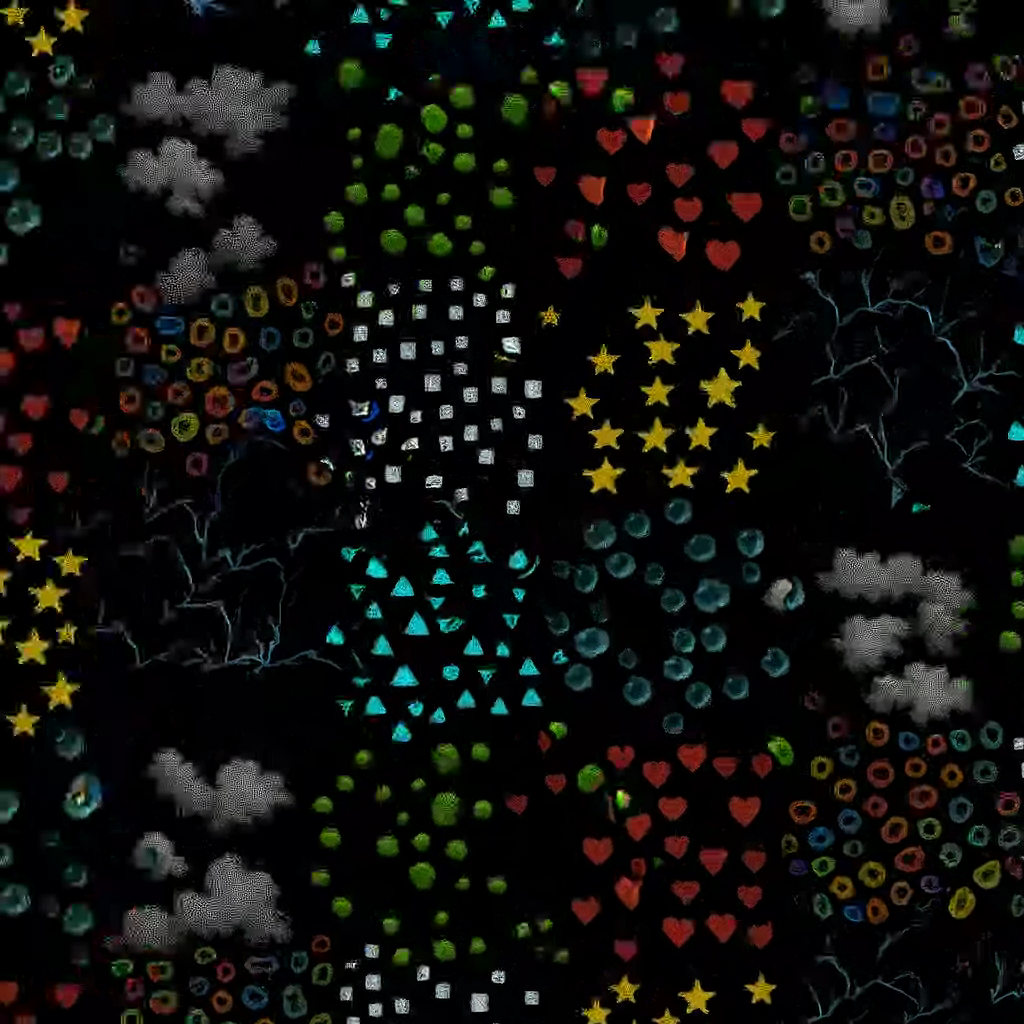
We introduce Neural Particle Automata, a Lagrangian generalization of Neural Cellular Automata where each cell is a particle with a continuous position and internal state, using differentiable SPH operators and memory-efficient CUDA kernels to scale learned self-organizing particle dynamics.
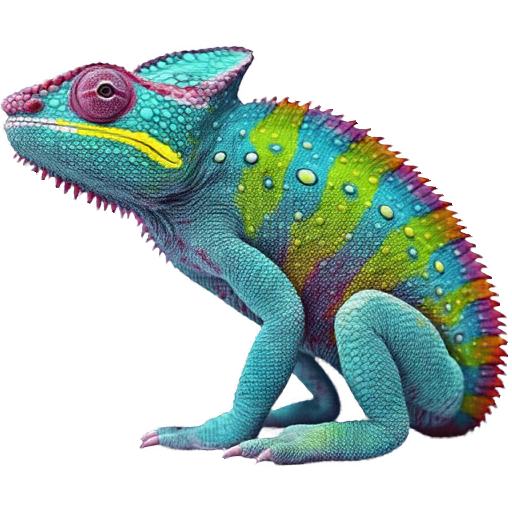
We pair a coarse-grid Neural Cellular Automata model with a lightweight implicit decoder that maps cell states and local coordinates to appearance, enabling self-organizing NCA outputs to render at arbitrary resolution in real time while preserving regeneration, robustness, and spontaneous dynamics across 2D, 3D, and mesh domains.
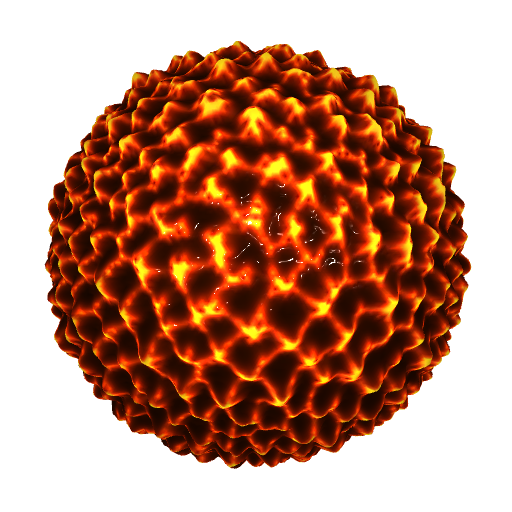
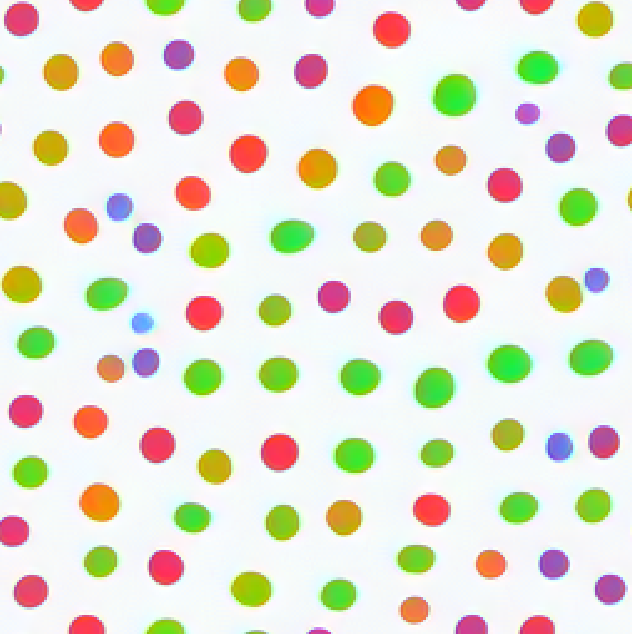
We analyze NCA texture models in the continuous space-time limit, show that standard training overfits discretization near the seed, and use uniform-noise initialization to learn dynamics that stay consistent across resolutions, are robust to stochastic updates and additive noise, and behave like PDEs.

DyNCA enables real-time and controllable dynamic texture synthesis, producing arbitrarily long and arbitrary-size video textures while improving synthesis speed and quality by orders of magnitude over prior optimization-based methods.
all publications
2026
Neural Particle Automata: Learning Self-Organizing Particle Dynamics
We introduce Neural Particle Automata, a Lagrangian generalization of Neural Cellular Automata where each cell is a particle with a continuous position and internal state, using differentiable SPH operators and memory-efficient CUDA kernels to scale learned self-organizing particle dynamics.
2026
Neural Cellular Automata: From Cells to Pixels
We pair a coarse-grid Neural Cellular Automata model with a lightweight implicit decoder that maps cell states and local coordinates to appearance, enabling self-organizing NCA outputs to render at arbitrary resolution in real time while preserving regeneration, robustness, and spontaneous dynamics across 2D, 3D, and mesh domains.
2025
Exploring the Landscape of Non-Equilibrium Memories with Neural Cellular Automata
2025
The Mokume Dataset and Inverse Modeling of Solid Wood Textures
We present Mokume, a solid-wood dataset of 190 cube samples with high-resolution photos, ring annotations, and CT scans, and introduce a three-stage inverse pipeline that reconstructs globally consistent 3D growth fields and volumetric color textures from exterior photographs using procedural and NCA-based synthesis.
2025
Volumetric Temporal Texture Synthesis for Smoke Stylization using Neural Cellular Automata
We present VNCA, an efficient volumetric style-transfer model that synthesizes multi-view-consistent stylization features for target smoke in real time while preserving temporally coherent transitions across frames.
2025
Canonical Latent Representations in Conditional Diffusion Models
We identify Canonical Latent Representations in conditional diffusion models and use them in CaDistill to transfer core class semantics through compact representative latent samples, enabling strong robustness and generalization with only a small fraction of the original training data.
2024
Mesh Neural Cellular Automata
2024
NoiseNCA: Noisy Seed Improves Spatio-Temporal Continuity of Neural Cellular Automata
We analyze NCA texture models in the continuous space-time limit, show that standard training overfits discretization near the seed, and use uniform-noise initialization to learn dynamics that stay consistent across resolutions, are robust to stochastic updates and additive noise, and behave like PDEs.
2024
Emergent Dynamics in Neural Cellular Automata
We analyze the relationship between NCA architecture and emergent motion in the dynamics by varying cell-state dimensionality and MLP width, showing that their disparity and proportionality strongly correlate with motion strength and provide a practical design rule for dynamic NCAs.
2023
DyNCA: Real-time Dynamic Texture Synthesis Using Neural Cellular Automata
2022
CLIPasso: Semantically-Aware Object Sketching
2022
Optimizing Latent Space Directions For GAN-based Local Image Editing
2020
ChOracle: A Unified Statistical Framework for Churn Prediction
ChOracle models churn through user return-time prediction by combining temporal point processes, recurrent neural networks, and latent loyalty variables, and uses an efficient variational backpropagation-through-time training method that generalizes across diverse real-world datasets.
2018
Back to Square One: Probabilistic Trajectory Forecasting Without Bells and Whistles
We propose an auto-regressive spatio-temporal CNN that outputs explicit probability distributions over future trajectories from visual input, and show that this simple probabilistic baseline matches or outperforms more complex methods on MNISTseq and Stanford Drone benchmarks.